
ECTOCOMP is a yearly interactive fiction game jam celebrating the month of Halloween. It looks like a chill jam and has a very good AI policy (it’s not allowed), so give it a look on Itch.io. There’s even a category for folks who want to speed write a game in four hours or less if you’re someone like me who cannot devote lots of time to a game jam.
interactive fiction
Loved the Incredibly Ambitious Interactive Fiction Game PARA//LLAX
Developer: Stanwixbuster
Year: 2026
Genre: Interactive Fiction
System: Browser
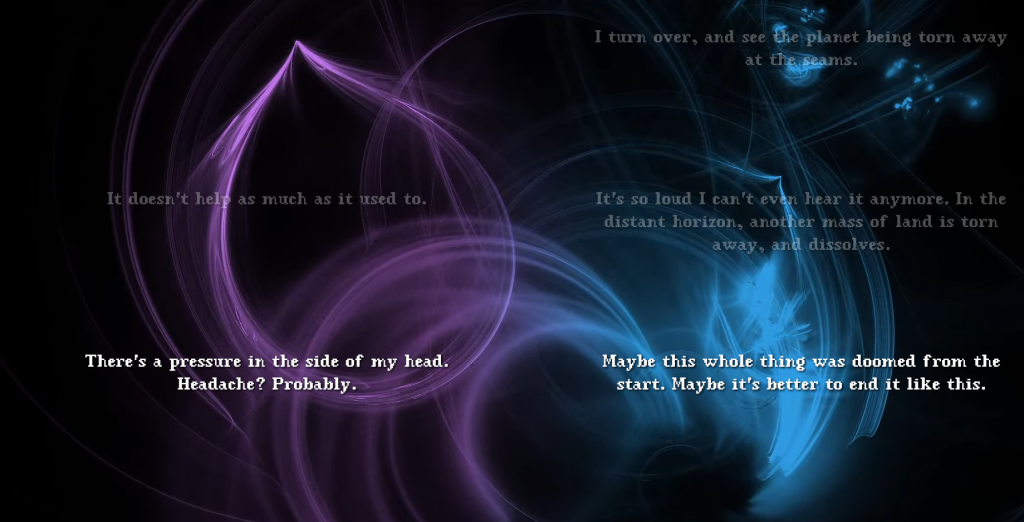
PARA//LLAX is an interactive fiction game created by Stanwixbuster for the Videotome 3 Jam about two men who wake up with a hole in their chest. The story is told by two separate columns with the men describing what they see, and advanced asynchronously by advancing one column at a time using the left and right arrow keys or both at the same time by pressing down. My limited experience with games made using Videotome is that they’re linear and the story is advanced with a mouse click or keypress until you finish the story. That’s certainly not a criticism. I think even a limited interaction like that changes the reader’s relationship to the story compared to if it was a book or post, but it really surprised me to see that you could do asynchronous storytelling using the engine. It’s not something I’ve seen before and the implementation was far more ambitious than I had expected.
When I saw that you could advance the story on either column, I figured that it was still going to be a linear narrative and they eventually end at the same point but the game has 27 end states. I wasn’t able to find them all but the branching storylines all felt very unique. I can’t even imagine how much work must have gone into writing all of them and building out all the branches, but it was a perfect fit for the surreal body horror story this game is about. I also felt the ambient music and different colored graphics for each side of the screen for each man are used well to immerse the reader.
Body horror probably isn’t going to be for everyone and I do recommend reading the content warnings before playing but I can’t recommend PARA//LLAX enough to anyone who is a fan of interactive fiction.
PARA//LLAX is available in the browser on Itch.io.
Text Adventures Still Rule in the Year 2026
I think a lot of folks who follow this site already know this but people still make text adventure games like during the days of Infocom and they’re still very good! In fact, I think many of them are even better than the classics. That’s not to say the classics are bad, they’re very good, I just think many made post-golden age of text adventures are even better. You can download many free ones on IFDB.
Some that are friendly to beginners that I happen to enjoy are Lost Pig, Galatea, Bronze, and The Dreamhold, but there’s a nice list of more interactive fiction on IFDB’s top 100 list if you’re looking for more to play. Not all of these are text adventures but I also love interactive fiction in the form of Twine games and other forms so no complaints there. I think the commercial text adventure Thaumistry is a good intro to text adventures as well.
If you want to download these free games instead of playing them in a browser, you’ll probably need something to run the files. I think Gargoyle is neat but there’s plenty of options. Some games are also easier to play if you map out the rooms. Personally I love writing these down in a notebook but Trizbort is a nice app for mapping rooms on your computer. I use a desktop version for Windows but apparently there’s now a browser version available.
If you want to see what else folks are up to in the scene, I recommend exploring the rest of IFDB and checking on competitions like IF Comp and Spring Thing. IF Comp has been going on since the 90s. While I stopped following that one for a while because they allowed AI stuff, it seems like they’re starting to clamp down on it so that’s nice.
Anyway, if you’ve never played a text adventure before, give it a shot! Maybe you’ll discover a new genre of games you really enjoy.
DAWN CHORUS [DEMO]
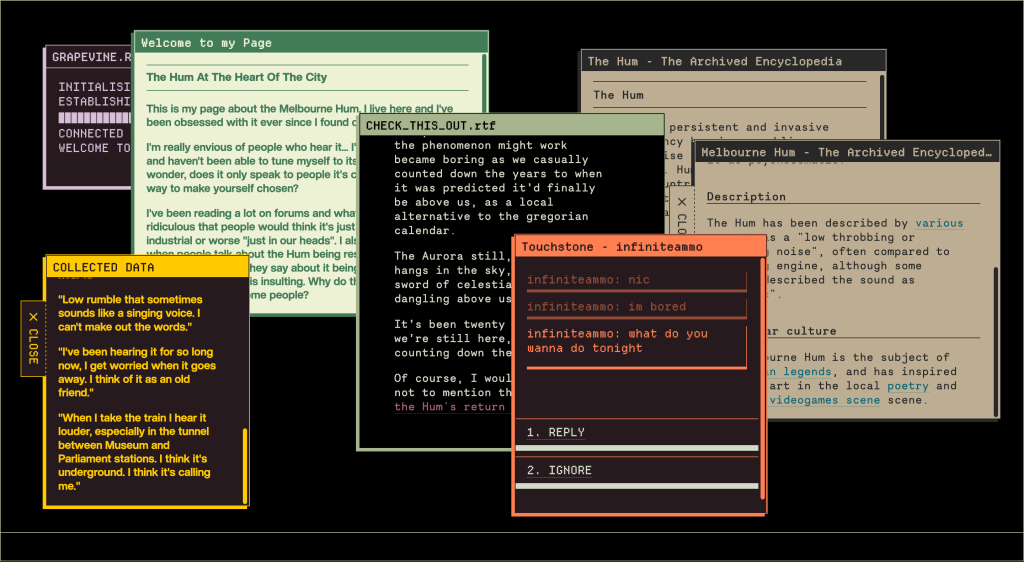
DAWN CHORUS is an upcoming interactive fiction game that recently had a demo put online after being shown at ALT: GAMES 2026. The 30 minute demo tells a story about two friends and a band named Dawn Chorus while the world is falling apart. I loved how it uses links that pop up new windows to expand on the world the game is set in, and the art and music do a fantastic job of contributing to the melancholy feeling of trying to live your life while the world is ending. I think the influences section is worth reading too. The sad feeling the game has reminded me a lot of Kentucky Route Zero so it was fun to see that listed after I had played through the demo. It also lists a few DOMINO CLUB games if you want to see the Jupiter Engine and make a game yourself that uses the popup window functionality this game has.
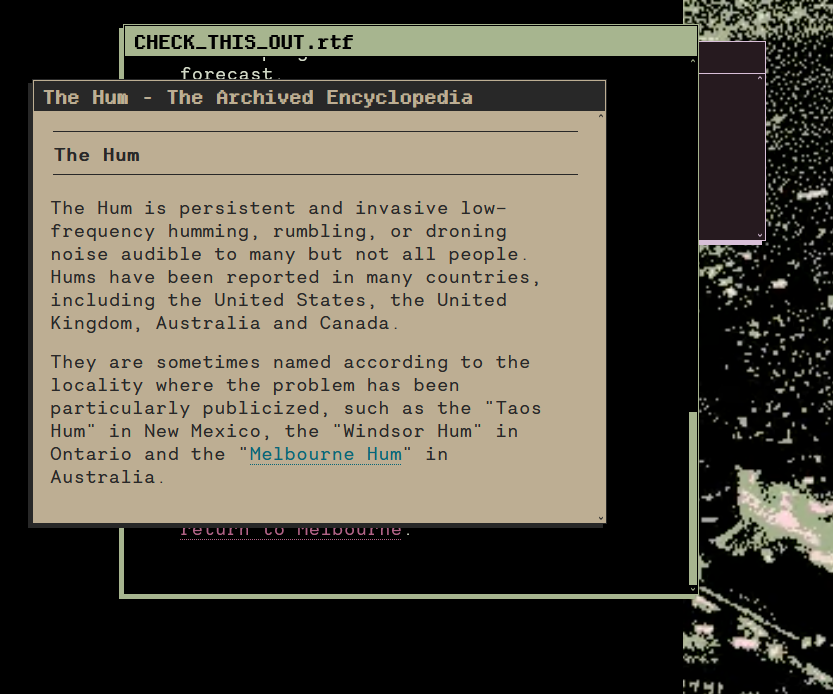
Something that caught me by surprise was the brief mention of the Windsor Hum. I always get excited about things local to me appearing in video games so that was a fun reference. It was a humming noise that people in Windsor, Ontario could hear from 2011 to 2020 and probably came from a factory on an inland between Canada and the USA but was never completely confirmed. You can read more about it on Wikipedia. There’s also a song by Detroit post-punk band Protomartyr that references it.
There’s not much else I can say about the demo without spoiling it but I think it was very well written and I’m looking forward to the full game.
DAWN CHORUS [DEMO] can be played in the browser on Itch.io.
Tabletop RPGs Inspired By Adventure Games

It’s not surprising that there’s a lot of tabletop rpgs based on video games. They often have an interesting universe to base a tabletop game on and many already have rpg mechanics, where while it’s not a 1:1 conversion to a tabletop game it does give designers a place to start. What I was surprised by was the number of tabletop rpgs that are based on or directly inspired by adventure games. I knew a lot of ttrpg creators grew up playing them but there’s quite a few that mention specific games or license the IP. Here are the ones I could think of but please let me know if the comments if I left anything out.
Myst
With Myst being one of the best-selling games ever, it’s not surprising that it has inspired a few tabletop rpgs. Unwritten: Adventures in the Ages of MYST and Beyond is a game that uses the Myst license and uses the FATE core system for the foundation of its rules. The game is strongly influenced by Uru/Myst Online and has players exploring modern or historical D’ni and the ages connected to it. The game has received a few smaller supplements as well as a larger sourcebook that was recently Kickstarted and focused on the reconstruction of D’ni
There’s fan games too. Bring the Page With You is a free one-page ttrpg where there is no GM/DM and is focused on players collaborating together to create Myst ages.
Text Adventures
There’s also a few games inspired by the Infocom-era of text adventures. Parsely is a collection of games where a group of players control one character by telling one player, known as the Parser, what they would like to do in the form of text adventure commands and the Parser describes what happens next. The collection even features a trilogy of Zork-like games known as Action Castle. The creator of Parsely has a few games in the series on their Itch page.
They’re not the only one to develop group text adventures. Goldfinch Games has developed a couple Out-Loud Text Adventures as well, with one in an abandoned amusement park and one at an abandoned spaceship.
Uresia: Grave of Heaven is a system-neutral setting book by S. John Ross that is strongly inspired by the Zork series, with there even being a section explaining how it influenced the book and why they love the series so much. The book is now available for free here. Check it out and then consider hiring him for book or map design if you’re a ttrpg designer. The author also wrote a Z-Machine text adventure game that ranks as Polite on Andrew Plotkin’s cruelty scale. This game is also available for free.
Point-And-Click Adventures
I found a few games on Itch.io inspired by point-and-click adventure games. Pocket Full of Stars is a cozy two-player ttrpg inspired by Samorost where the players have the roles of an Astronomer and the Storyteller and work together to tell a story about a giant jumping from planet to planet and meeting people.
Loom is a fan fiction game based off the classic Lucasarts adventure game of the same name. It’s a solo journaling game where you explore the game’s world using the mechanics described in the book and write about what happens. Both games are available as Pay-What-You-Want.
Citizen Sleeper
With it being so strongly inspired by indie tabletop rpgs like Blades in the Dark, it would make sense that Citizen Sleeper has its own tabletop rpg. It’s not actually out yet so I can’t say much about it but it is available for pre-order here.
TTRPG Supplements
Instead of developing their own systems, many designers have created supplements for existed games. Blood Mountain Resort & Spa is a free download for fantasy ttrpgs. Inspired by the Monkey Island series, players explore a pirate themed resort. The NPCs are statted for DURF but the rest of the supplement is built to be system neutral. Lost to the Starlit Reptiles is another adventure for DURF by the same folks that is inspired by adventure games.
In Other Waters: Tidebreak is a supplement for the horror ttrpg Mothership that is set in the In Other Waters universe. The supplement is playable in either as a group or solo and designed to be less stressful than the typical Mothership adventure.
Let me know if I’ve left anything out. I would love to know what else exists out there. If you enjoyed this article you can play any of my tabletop rpgs inspired by adventure games like Accomplice, my Gabriel Knight inspired solo game, Alone in Cyberspace, inspired by Hypnospace Outlaw, Friendship Quest, my two-player map drawing game, and ERROR, a play out loud text adventure. The first two games are paid but just take a free community copy if you’re interested.
Indie Game Roundup ( Nov. 24, 2023)

It’s Itch.io’s Creators Day, where they aren’t taking a cut from sales today. I’ve put all my paid games in a little bundle you can pick up if you want some solo TTRPGs.
Shannon McMaster has a cool and free system-neutral guide to hex crawling in time dimensions for your tabletop rpg.
Misty has a great post on Cohost about all the games she enjoyed playing while judging for the Independent Games Festival.
Hand Eye Society’s Super FESTival is still going on. Check out all the great talks and indie games going on.
Goose has made a very good demake for the Game Boy of a game they previously made a decade before for a game jam.
James Chip has a new solo journaling game set in space. It’s based off their previous game The Adventurer and seems very cool.
The results of this year’s IFComp were just announced and as usual, it’s another great batch of interactive fiction games that are worth your time.
In Stars and Time looks like a very nice time loop rpg that’s now available on Steam.
There’s a new Indie Tsushin, highlighting indie games from Japan.
Tristam Island is now open source and released under a Creative Commons license. It seems like a great reference if you’re looking to build a text adventure game in PunyInform for retro platforms.
Making Niche Games Popular
I keep seeing a post on one of the social media sites that instead of trying to make niche genres like Interactive Fiction more mainstream and financially viable, people should just focus on the craft instead. And since people keep sharing this weird take that I strongly disagree with, I guess I have to explain why I don’t like it.
I really don’t think it’s unreasonable to want interactive fiction to be more mainstream and commercially viable nor do I think it’s an unobtainable goal. A lot of people read so why couldn’t reading with some interactivity be commercially successful too? It was a financially viable genre for like, 10-15 years, and could still be considered one if you’re talking about companies like Choice of Games and games like Lifeline being huge hits. Depending on your definition of the genre, visual novels are a part of IF and are massively popular.
Obviously capitalism is bad and there’s more to making games than if they can make a lot of money but why shouldn’t we push for more visibility of games that are only considered “niche” because don’t pander to some bro gamer culture. If we’re talking about games made with Twine and Ink, it’s one of the most approachable ways to make games and one of the genres where I see the most queer stories. I really think that the thing that keeps IF from being bigger, especially with non-parser IF, is that a lot of people who love to read just don’t know about it.