
ECTOCOMP is a yearly interactive fiction game jam celebrating the month of Halloween. It looks like a chill jam and has a very good AI policy (it’s not allowed), so give it a look on Itch.io. There’s even a category for folks who want to speed write a game in four hours or less if you’re someone like me who cannot devote lots of time to a game jam.
adventure games
Transfer Point thoughts
Developer: Mike Piontek
Year: 2026
Genre: Adventure
System: Macintosh
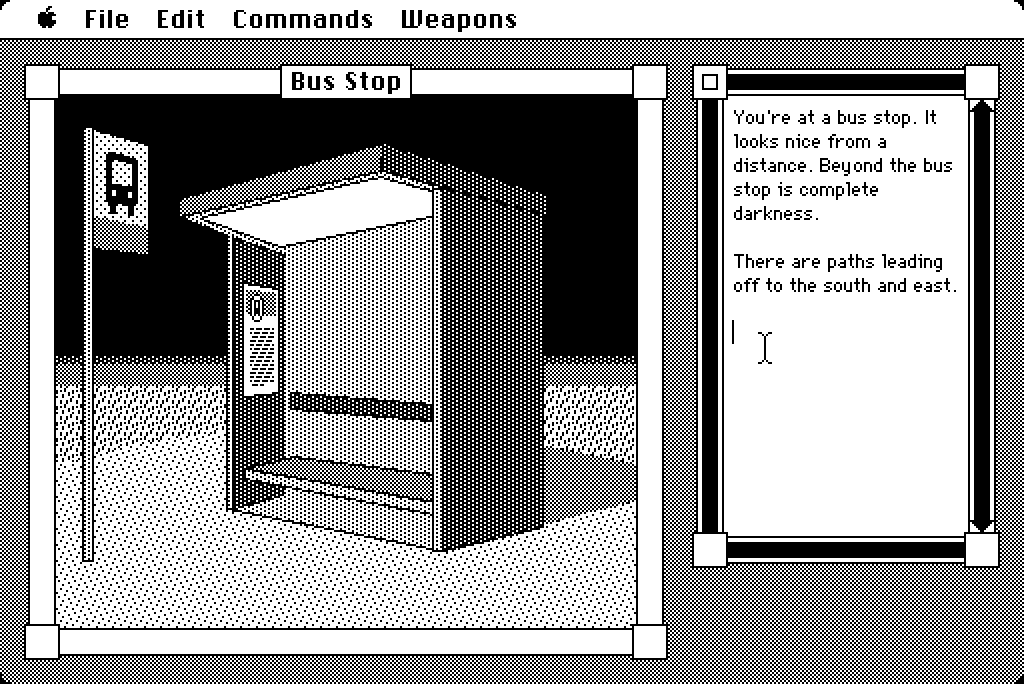
After posting about the game in an indie game roundup early this year, I finally made the time to play through Transfer Point. Transfer Point is a new adventure game for the classic Macintosh, but playable in the browser as well. It was created in World Builder, a program released on the Mac in 1986 that allowed people to make their own games. You play as a woman who finds herself at a bus stop, but with no memory of how she got there and only remembering parts of her past. The game itself is first person, with you using a combination of clicking on things and typing into a text parser.
I was very excited to play this one and wasn’t let down. I had occasionally watched Mike design the game on his robotspacer Twitch channel and thought it looked great. Even though I didn’t grow up with this era of the Mac, I love how games on the platform look with their black and white art. It’s just very comforting to me. Luckily the rest of the game is solid as well. I enjoyed the story in this (you play as a woman married to another woman!!, not really a spoiler!) and while it’s not really a comedy, there’s some bits in here that I thought were very funny. There was a death scene in the game near the very beginning that I absolutely loved and made me really happy to see. It’s not a game with many deaths if you are an adventure game fan concerned about running into them. A nice thing about waiting a day or two to write a post about a game is that I can think about some plot elements for a bit before really settling on how I feel about them, which includes a twist later in the game, nothing too twisty really, that I wasn’t sure about at first but I like it. I think the puzzle design is solid for the most part too. There was one puzzle that even the Invisiclues apologizes for, but other than that one I think the game has good and fair puzzle design and if you do get stuck, the designer has provided the Invisiclues to look at, which give you small hints instead of spoiling a puzzle completely. I would love to see more adventure game devs provide this with their games.
Since I have only played a few World Builder games before this, I was fascinated by the things that seem like requirements for making something in the engine. The game has a Weapons column, but you never need to attack anything. The designer manages to make use of the section by placing “use rapier sharp wit” under there and makes it work, but I think it’s fun seeing people work with engines like this that force the designer to make choices like that. There’s also a Search command, I think it’s probably a leftover bit from text adventures, that you basically use in every room to see if there’s anything hidden. It’s a little odd if you don’t play text adventures since you can see what you’re looking at in the panel on the left, but it’s necessary for completing the game.
I’m trying to avoid talking too much about specific elements in this that I loved because it’s a fairly short game (took me about 1-2 hours) and spoilers in adventure games can sometimes hurt enjoyment for some players, so apologies about being so vague about the content, but I highly recommend this if you’re a fan of adventure games and the classic Macintosh look. While you can buy the game on Itch.io to get a version of the game that runs on Macintosh and also some nice bonus materials, you can also play it in your browser window if that sounds much easier for you. There’s a version in development for the Playdate to look forward to as well, which you can follow development of on Twitch.
Transfer Point is available for Macintosh and browsers on Itch.io.
Text Adventures Are Still Doing Alright
Even though the general narrative online seems to be that text adventures died with Infocom (which I disagree with for many reasons of course), it’s nice to see that there’s two notable Interactive Fiction and Text Adventure events happening at the same time. The first is that the 32nd Annual IF Comp is now live! There are 71 new interactive fiction entries to play and vote on. Not all of them are pure text adventures but the entries let you know what type of Interactive Fiction it is. I love choice based games as well so this is not an issue for me. It’s also just wild to me that it’s been going on for so long. I always forget that the Post-Infocom Text Adventure era or whatever you called it really did start that early on while folks like Legend were still making text adventures.
The only heads up I’d like to give is that while they put much heavier restrictions on gen AI usage, I believe they do not have anything for code because it would be impossible for them to enforce. While I personally disagree and think it’s worth having anyway, even at least a disclosure requirement, I get it. I’m not going to fill up this post with complaints. Just know that you should dunk your head in a toilet if you use it.
The second Interactive Fiction related item I’d like to mention is that it’s the final week of voting for IntroComp. IntroComp is described as “an annual competition where participants develop excerpts of interactive fiction, gain feedback from audience reactions, and (hopefully!) use this feedback to release a fantastic final product.” Check some games in development out and help some games get made!
And if you’ve never played a text adventure, give it a shot. Many of the Interactive Fiction games on this Interactive Fiction Database list are text adventures and available for free. It’s a bit of a cliche to recommend Lost Pig but it’s a good one! You may also like Bronze, Shade, or Photopia. Just click around and start playing one that sounds interesting to you.
Text adventures: They’re neat!
Croustibat review
Developer: Coktel Vision
Publisher: Findus
Year: 1995
Genre: Adventure
System: DOS
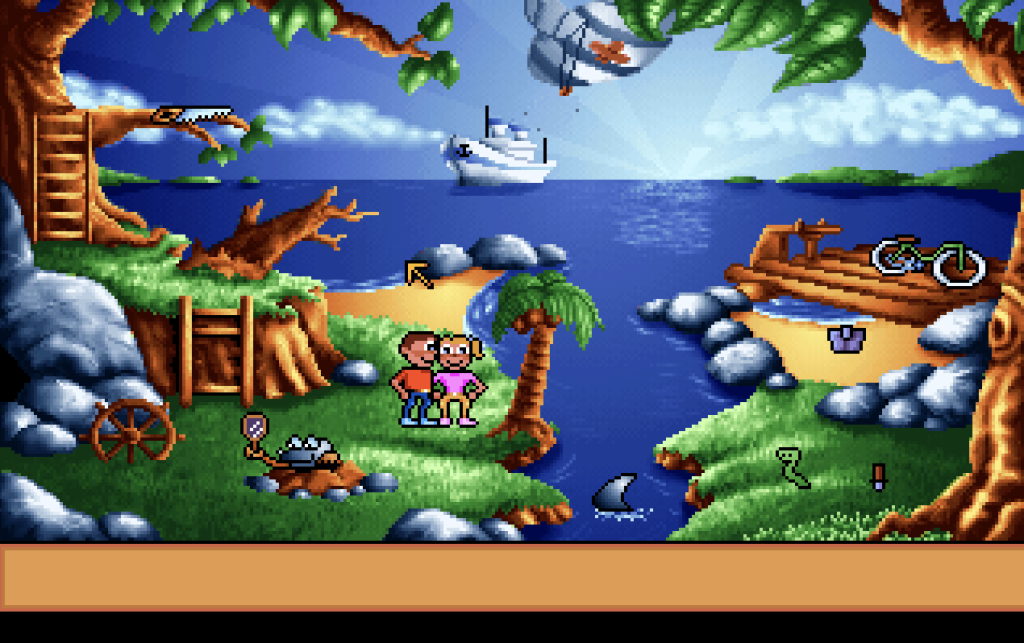
After issuing a challenge to folks to blog about an obscure game, I figured I should probably engage with this as well so I pulled a game that has been sitting on my backlog for a long time, Croustibat. Croustibat is an advert game for the Croustibat line of fish products by Findus and prominently features the mascot, a fish that is also named Croustibat. Apparently you could get the game by sending a letter to Findus along with the money to cover shipping and handling. The game was developed by Coktel Vision, the folks who developed the Gobliiins series of adventure games. It plays very similar to those games, especially Gobliins 2.
You have two characters, a boy and a girl, and must solve puzzles by doing your typical adventure game stuff like picking up items and using them on objects. There is technically a plot about aliens attacking a boat but it’s basically non-existent in the game itself, with instructions focusing on getting to the next location. Only specific player characters can successfully use objects and inventory items, but you don’t really know who until you try both player characters. Much like the Gobliiins games, the lack of hints or instructions mean you do a lot of brute forcing in this one as well. I didn’t think it was as frustrating as some of those games though, since it’s aimed more towards children and you are only on one screen at a time so the amount of objects to interact with is very small. I think this is a good thing. I am a fan of the Gobliiins series but nearly all the games in the series have a few puzzles where you brute force item combinations just to make some progress. That said, there was still a moment or two where I did not understand why the solution I tried worked, which is never a great sign.
I suppose the main gimmick in this one is that during each screen/level, the Croustibat mascot’s hat will appear. Picking it up will make the mascot appear and give you fish sticks, which make you extra strong. This is only ever used by the girl and exists to help her with a specific puzzle on each screen such as cutting down a tree. I’m assuming there’s someone out there on the internet that is physically attracted to the Croustibat mascot but I’m not going to confirm that.
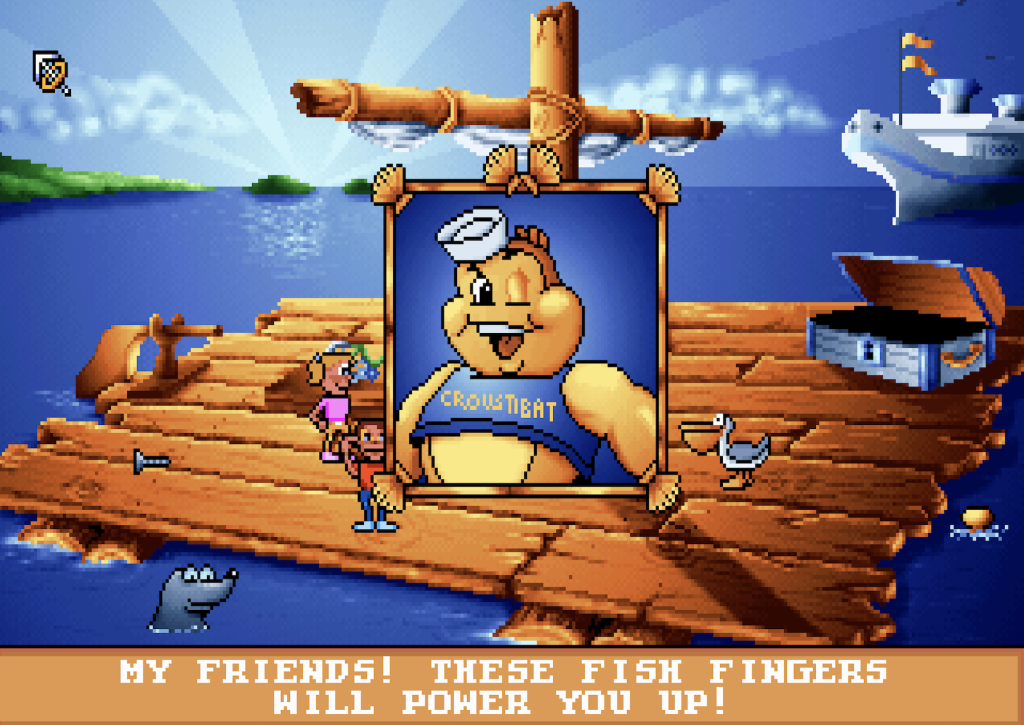
Unlike Gobliiins, none of the player characters are interesting to watch or really do anything funny when you fail to do an action, which is sorta the highlight of those games. It makes sense, you aren’t going to beat up children too much in an advert game for kids, and there’s still moments like a child being frightened by a spider or a coconut falling on their head, but it does mean that there isn’t a lot going on. The kids don’t really have their own personality like the Gobliiins games either. I still think the art for all the characters is charming enough though and it has some fun animations.
My only other real gripe is that you need to transfer items between characters and it frequently just did not work for me so I had to keep trying until it would eventually work.
I wouldn’t necessarily recommend the game if you’ve never played the Gobliiins games before, unless you have a fascination with advert games or a strong nostalgia for 90’s adventure games. It’s not actually bad but it’s also not very interesting either but there’s worse ways to spend 15-20 minutes. I think the game is far more interesting if you played the Gobliiins series since it is by the same devs, plays very much like an easier Gobliins 2, and even uses a lot of the same sound effects and cursor. You can find the original French version across the internet since it was a free game but I played the unofficial English translation on the Internet Archive, which is playable in the browser but I downloaded it and ran it in ScummVM.
On a weird final note, my 6 year old saw me playing Croustibat and said “Are you playing that Goblins game?” I didn’t even think I had played any of those with her before (maybe Goblins 3?), certainly not in a long time, but now I will be thinking about if I play too many weird French DOS games around my kids or not. Then again, I could also get that Gobliiins Collection on the Switch which features mouse support for the Switch 2.
Croustibat is available on your favorite abandonware site such as MyAbandonware, with the unofficial English translation on the Internet Archive.
The Joy of Revisiting co-open with My Kids
Developer: lowpolis
Year: 2021
Genre: Adventure
System: Mac
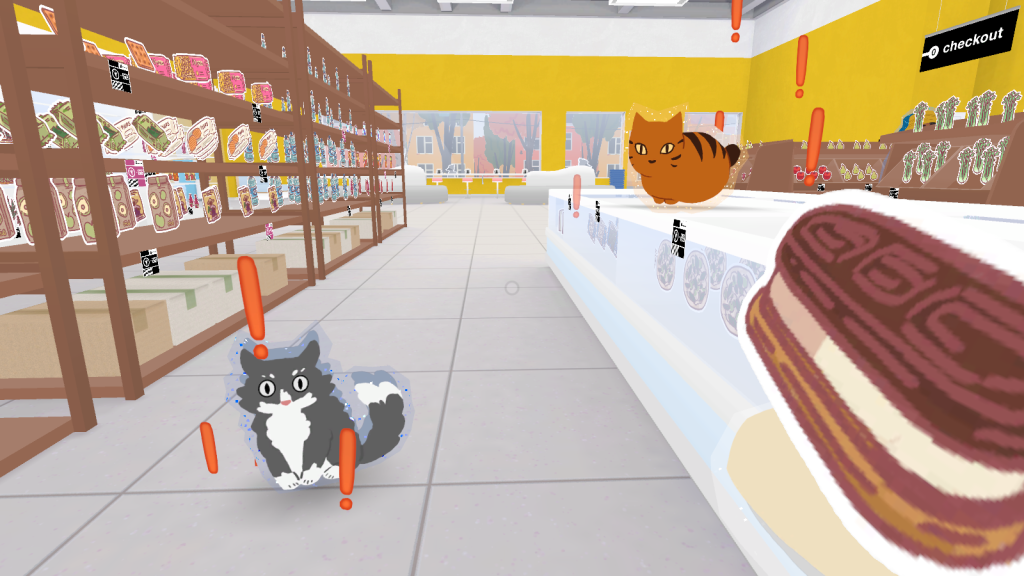
One thing I love doing is showing games I played years ago to my kids that I think they will enjoy. Recently one of these was the first-person adventure game/walking sim co-open. co-open is a game about a kid’s first time buying groceries on their own. While it wasn’t designed for kids in mind, my 6 and 9 year olds absolutely loved it. My oldest would be the one controlling the game and walking around while the 6 year old offered suggestions on what they should look at or explore next. I think in general they are just huge fans of games where you can explore a space without fear of losing, which is why they like Proteus as well, and co-open offers so much to look at but it’s all optional. If you want to do a simple trip to the grocery store, pick out a few items and leave, you certainly can and the game won’t look down on you for it. However, you can also talk to folks and help them with their shopping trip, find things like phone numbers to call, and explore and stumble across so much interesting stuff. The game just gives you so much to look at even with it being smaller in size, so I was really happy that my kids were into that and also enjoyed its chill vibes.
I think something else that kids are very good at embracing and I’ve lost is roleplaying in video games. They are happy to just explore a space and make up stories about the characters as they play. Another example is that my 6 year old loves playing Unpacking, with the puzzle elements turned off such as everything needing to be in the proper place, and just making up her own stories about all the objects. While I love roleplaying in tabletop rpgs, somehow I’ve lost this in video games and there’s a lot my kids are showing me in how someone can play a video game. Maybe I should have made up an elaborate backstory for the moose in Moose Life. It made me happy that co-open was a game they enjoyed and that my 6 year old still asks occasionally about playing “the grocery shopping game.”
co-open is available for PC/Mac/Linux on Itch.io and in physical format on the Videogame Tape Market.
Thimbleweed Park 2 Announced, Blog Launched
Ron Gilbert has just announced Thimbleweed Park 2, which you can already wishlist on Steam. I’m excited! I was a fan of the original game and I’m always happy to see Ron working on a new adventure game with the folks that made the first game.
As part of the announcement, you can also follow the development blog here. The post has a lot more details about what platforms the game will be on, if there will be a Kickstarter (no), and why (it’s already funded). I recommend checking the post out if you’re interested and adding the blog to your RSS feed reader. I think the thing I’m most looking forward to about the game is that both Thimbleweed Park 1 and Return to Monkey Island brought nice quality of life improvements to point-and-click adventures that the rest of the folks in the community adopted. Many got brought over to the engine I use, Adventure Game Studio, too. I also just like all the folks that worked on TWP 1 and that last Monkey Island so it’s always nice to see them continuing to work on games.
Adventure Games Are Doing Just Fine: July 2026 Edition
I’m still not back to doing indie game roundups just yet but I did want to give a shout out to all the adventure games coming out lately since there’s been so many lately but you wouldn’t know it from being in the adventure game community, which seems more content to complain about how it’s not the 90s anymore and ignores all the new stuff and experimentation happening in the space. Just this last month we’ve had:
The Incident at Galley House, a remake of last year’s Type Help, where you are investigating a mysterious death. I’ve only played a little so far but it’s been fantastic.
Endacopia, a horror point-and-click adventure made in Adventure Game Studio that’s only been out for a few days but already looks like it’s been a massive success. Again, wouldn’t know it existed since there’s been no real coverage of it from any adventure game outlets but it’s getting great reviews on Steam and looks like it’s doing some really interesting stuff with the engine. It sounds like the developer had a YouTube channel for a while so I’m guessing that’s where this massive audience came from. I do really like the 90s edutainment horror aesthetic although part of me is nostalgia poisoned enough that I think I would get more excited if it just looked like 90s edutainment but wasn’t horror.
Desktop Explorer is another 90s-inspired horror adventure game, but obviously through a desktop computer.
The Mermaid Mask is the third game in the Detective Grimoire series. I really should play these. They all have some great artwork.
I think a nice thing about all these releases is that they all seem to be massively successful too. Obviously commercial success isn’t an indicator of quality or what deserves attention but it’s still nice that there’s folks that can make a living doing this considering all the talk about it being a dead genre.
I also want to mention some other recent games. What Awaits, Aleksey? looks like a very challenging investigation game set in a Communist state and I’m curious how that is executed. Go North looks like a very interesting maze puzzle game that I first saw at a Game Devs of Color related event. I also need to finish playing A Lost Man and doing a writeup on it since I was given a key for it, but I do like that one a bit too. I previously wrote about really liking the demo, which is still available for you to try.
I still haven’t played Broken Reality but the sequel Broken Reality 2000 looks great. I really want to walk around in that space.
And finally, I also really want to make the time for the semi-autobiographical walking simulator Plum Road Tea Dream.
I just always find it fascinating to see what the adventure game sites and youtubers cover. It often feels like it’s just about how the genre isn’t what it used to be, casually ignoring the innovations that are happening so they keep complaining. Also plenty of complaints about how the games are too easy now and not playing any of the ones with more challenging puzzles. You’d think that Cyan showing off a whole prototype that couldn’t get funded would be worthy of a mention in adventure games news but I guess not! Anyway, the adventure game genre is doing fine.
Cyan Gives a Peek at Canceled Myst Prototype and Other Myst News
Cyan’s Mysterium convention is happening right now, which means all the Myst-related announcements are happening. The biggest one was a look at a prototype in the Myst universe that they were shopping around but never got funded. Project Anglerfish was going to be a first-person adventure game set in the universe but not a direct sequel and it’s absolutely killing me it didn’t get funded. A more horror leaning first person puzzle game right after Blue Prince won so many accolades seems like a slam dunk but no one was interested in funding it. I’m assuming it’s not something a Kickstarter would fund but I would happily throw money at it if they had one. Take a look
Alright, well with that painful news out of the way there was some good news too. It sounds like they’re still working on a game set in that universe, just not that one. The Myst books are getting reprints too. You can read about all of that and more on their website.
Caper in the Castro thoughts
Developer: C.M. Ralph
Year: 1989
Genre: Adventure
System: Mac
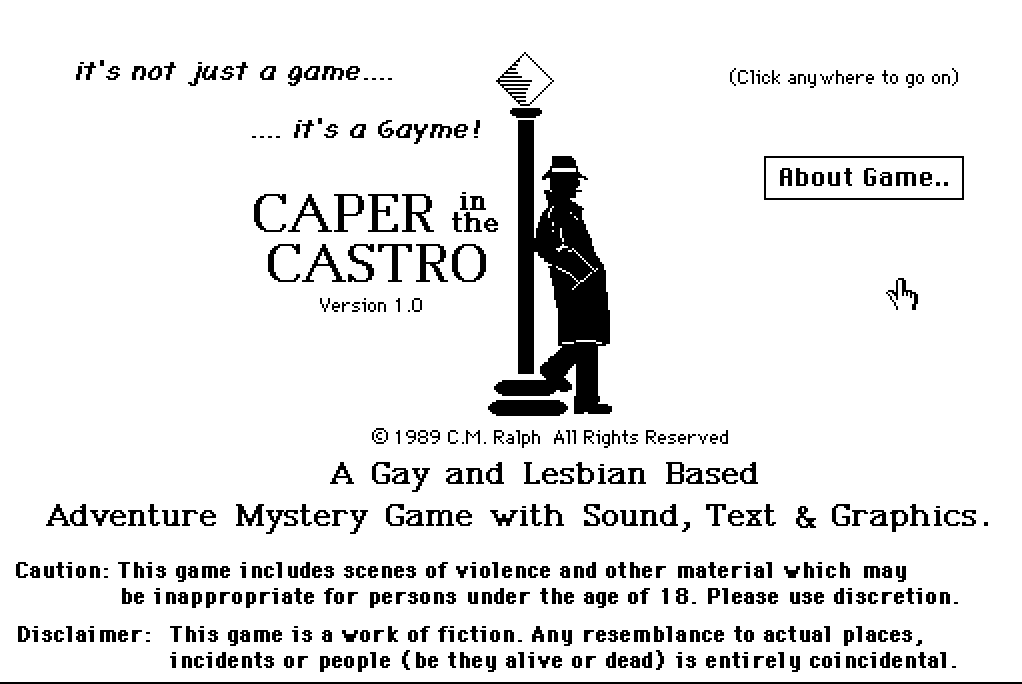
Caper in the Castro is a short point-and-click adventure game created in Hypercard and the earliest known queer game, so I thought it would be fun to check it out during Pride Month. You play as the lesbian detective Tracker McDyke who must find her friend, the drag queen Tessy LaFemme. It’s a very straightforward adventure game where you navigate up and down a street, going into buildings and poking around for clues. Since it was a simple game built in Hypercard, it doesn’t have any inventory items and progress is gated by various notes you take in the game that you will need to use elsewhere. There are death scenes that will force you to restart the game but it’s incredibly quick to get back to where you were before.
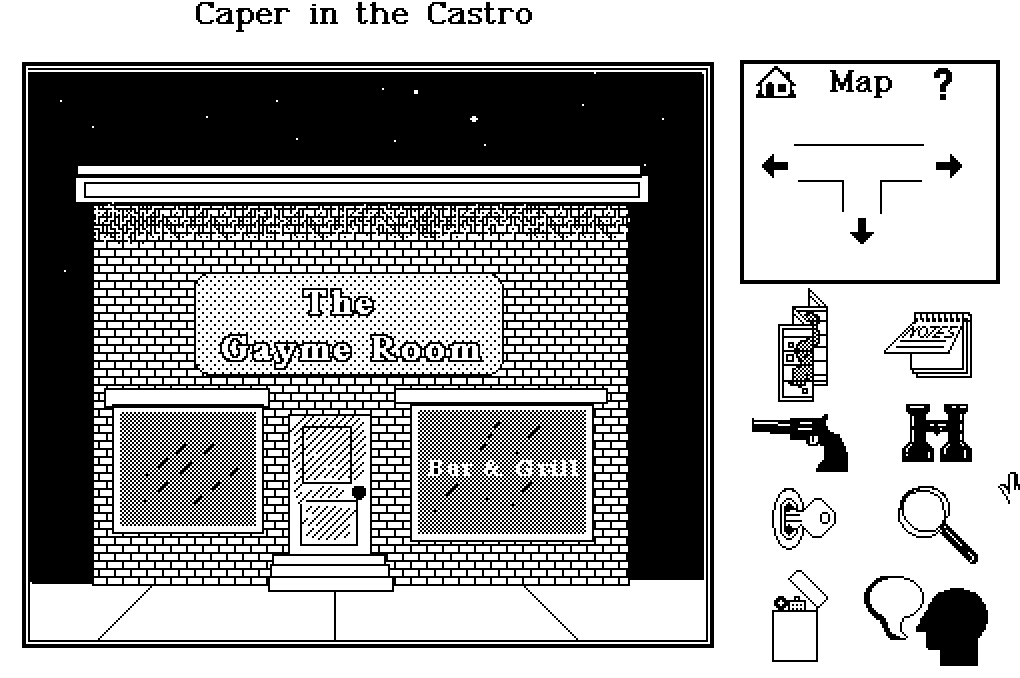
I have known about the game for a while but never actually sat down to play through the entire thing and I’m so glad I did. Any flaws the game may have from the lack of depth or the fussy parser, which you briefly use at a few points, was easy for me to overlook because of how charming the game is. I am an absolute sicko for this era of Macintosh games and Hypercard and I loved the art. The game was obviously made at a really dark time and the game encourages people to donate to AIDS charities as a form of paying for the game. I get very emotional seeing people creating queer art during this time and the fact that this was created to be charityware to help others was very moving to me. I was a baby during this time so I also always appreciate any queer art and writing that lets me see what the queer community was doing at this time. The game itself is very campy and messy in a way I really enjoyed (other than the dated language the author apologizes for on the Archive.org page) and I think it would fit in very well with what a lot of experimental queer games that folks are making on Itch.
I’d recommend it, especially if you are interested in queer and/or retro adventure games. It’s not the tightest puzzle design given that the author was working with a limiting tool they didn’t have a ton of experience working with, but I think the art and writing are very charming and it’s an interesting time capsule.
Caper in the Castro is available for free on the Internet Archive and you can repay the author by donating to your LGTBQ+ charity of choice.
A Lost Man adventure game demo explores life during World War 1
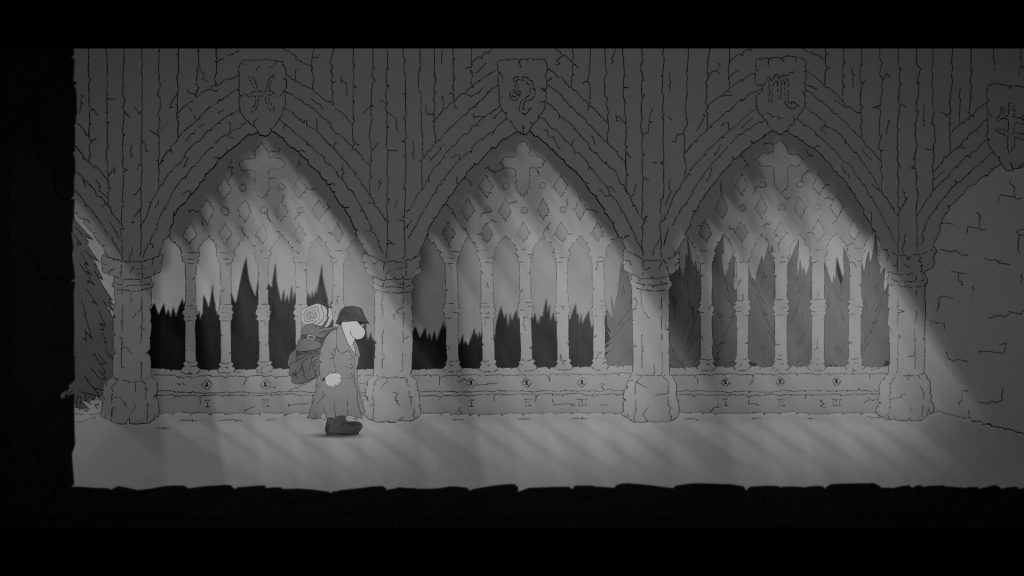
Maybe I should play more adventure game demos. I almost never do because I figure that if an adventure game looks interesting to me and people like it then I’ll probably get it at some point and playing a demo would just spoil a chunk. But that seems a bit silly now after trying a few recently such as A Lost Man, a point-and-click adventure where you are a lost soldier during World War 1. The demo (available on Steam) gives a very brief look at the game and one or two puzzles but it made me far more interested in the game. I felt the game does an excellent job of conveying a place that is close to the front lines but isn’t quite pulled in yet. There is some dry humor but it’s not a silly game and everything felt tonally like it should. I wasn’t sure how I would have felt about the art but it looks really good in motion. My only real complaint about that is that I think it needs a run animation instead of making the player walk fast, but it’s a unique style I haven’t seen in other adventure games.
I’m curious about the stuff I see in the trailer that wasn’t in the demo. Everything I played felt very grounded, so I’m not sure how the more puzzle-like parts will work but I’m guessing that it feels more natural when it’s all spread out over an entire game and not in a very short trailer.
Anyway, the demo is very short (about 15 minutes) so consider giving it a shot if it sounds interesting to you. Maybe I’ll try to do some demo roundups on here during the next Steam demo event.