Developer: Langford Productions Year: 2026 Genre: Arcade System: Windows
Screenshot taken from Itch.io
Ever since I came across the ZX Spectrum game Jetpac as an unlockable in Donkey Kong 64, I’ve been a big fan of it. Maybe it’s a little bit because DK64 itself is not an amazing game but I always loved that there were arcade games you could unlock and play in it like the original Donkey Kong and the ZX Spectrum classic. Since I grew up in the US and was born in the late 80’s, I didn’t really know about the Spectrum until quite a bit later but it’s been fun coming across games from that era that were considered highlights of the platform. Since Jetpac is my favorite, this means I end up playing any remake I come across on Itch.io and I think the new one by Langford Productions is the best I’ve seen yet.
If you haven’t played Jetpac, it’s a very simple arcade game where you’re an astronaut with a jet pack on a planet and must rebuild your rocket by flying around, grabbing parts, and dropping them off at the base of your ship. Once you do that you refuel your ship by grabbing cans of fuel and dropping them off at the ship too. All of this is done while dodging or shooting enemies that bounce around the screen. It’s all very simple but I think the game really holds up. The remake has a lot of additional options you can toggle on and off, which include:
Three graphic styles switchable in-game: the original ZX Spectrum, ZX Spectrum limitless colour, and new HD graphics. The new HD graphics are fine, they’re what you kinda expect with any HD remake of an old game. I don’t use them but they’re fine. I don’t really understand the limitless colour thing but it does make Jetpac look like an early 90s VGA DOS game, which I think is neat. Swapping the styles also changes the audio to match the fidelity of what you’re looking at, which I think is a nice touch too.
The platforms can randomly re-arrange with each new level
Fuel pods can explode when shot.
Lunar Jetman missile launcher. I’m less familiar with this one since I never played Lunar Jetman, the second game in the series, and only played the other sequel, Solar Jetman for the NES. But basically you have a missile launcher that stays on the ground and shoots homing missiles at you.
Swapping the enemies from the developer’s other ZX Spectrum games Cookie and Pssst. Again, I never played these but it basically gives you more variety by swapping out the original game’s enemies with new ones.
It’s a very nice remake and I’d recommend it if you’re looking for a fun arcade game to play, whether you’ve played the original or not, and then you can check out the other ZX Spectrum remakes by Langford Productions.
The Jetpac remake by Langford Productions is available for Windows on Itch.io.
The bespoke emulator DREAMM has now reached version 4.0! DREAMM is an emulator focused entirely on games from Lucasfilm Games/Lucasarts. “Why would I use this instead of ScummVM?” you may ask, well, this includes tons of stuff that aren’t adventure games like Jedi Knight, X-Wing, Tie Fighter, and that sort of stuff. It’s also more focused on emulating the games to play how they did at release, with the original menus and not the various other tweaks that ScummVM makes. It’s all by Aaron Giles, who worked at Lucasarts back in the day, doing a lot of porting work, and I guess a modified version of this was used in the recent Rayman release.
The big update this time is support for some late 90s Lucasarts games, all the Lucas Learning stuff, and Monopoly Star Wars and Willow, which I don’t believe were published by Lucasarts but are obviously connected to that world. Monopoly Star Wars is not a great game but I did play it quite a bit at the time. The Lucas Learning stuff is interesting because none of it is available today and DroidWorks, a neat 3D game where you build a droid and walk through levels solving puzzles, has been a massive headache to get working on modern computers for a long time. The other ones in here that I’ve played before are The Gungan Frontier, which is basically a sim game with the Gungans from Episode 1 and Pit Droids, which is kind of a Lemmings/Chu Chu Rocket-like.
Anyway, it’s really neat that this exists and it’s completely free. You can check out all the games it supports here.
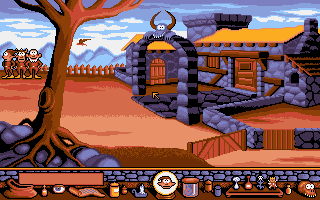
I was really excited that Gobliins 6 recently came out on Steam and Itch and wrote way too many words about why I love it on the No Escape forums. So I’m doing the normal thing and expanding on that post even more. If you haven’t played the Gobliiins series, it’s a weird French point-and-click adventure game in a series that started in 1991. The rest of this post will be about why I think the series is interesting and some of the quirks but the TLDR is: it’s good! You don’t need to play previous entries.
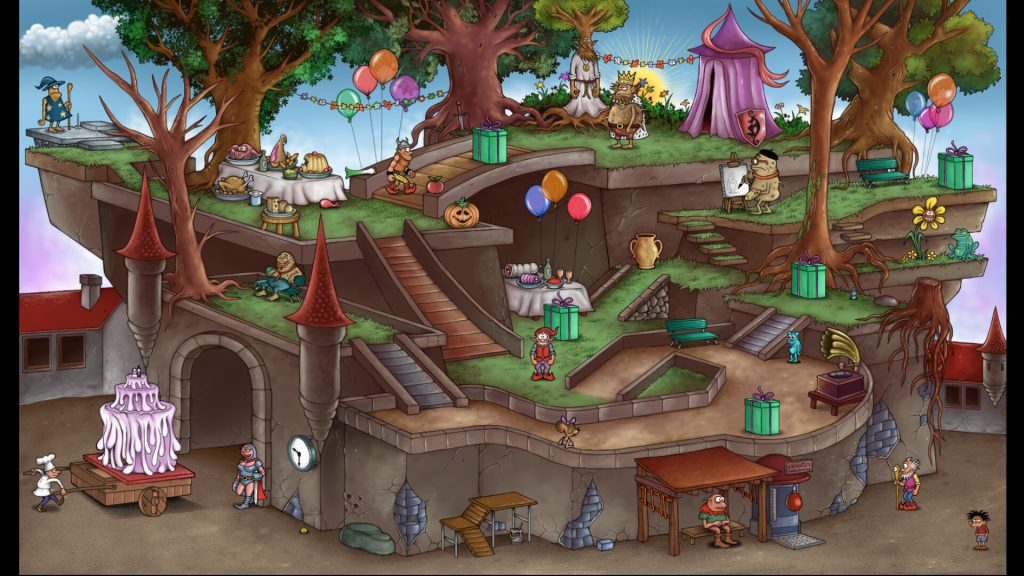
Gobliiins screenshot from MobyGames
Anyway, it’s a series where you control a group of goblins that you switch between to solve puzzles. The entries vary on how many you play as at a time, and it’s technically an adventure game but they typically follow a level-based format where you have some specific goal and you solve puzzles to accomplish that goal before you move onto the next level. The original three games were created by Coktel Vision and designed by Pierre Gilhodes and Muriel Tramis. Muriel has a FASCINATING career. She’s known as the first Black woman video game designer and many of her games are focused on anti-colonialism or erotica. The Gobliiins series is not about either, but Pierre and Muriel did eventually do a game called The Bizarre Adventures of Woodruff and the Schnibble, which has all the goofy humor of the Gobliiins games but is anti-colonialist. It’s a weird game but I love it. Most people in the US who know of these games probably know about them because Sierra bought Coktel Vision and published their games here. They even renamed the third game to Goblins Quest 3, to make it sound more like King’s Quest/Police Quest/Space Quest, which is so goofy to me since it’s this bonkers French game but there you go.
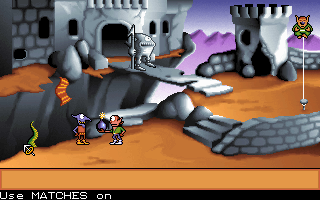
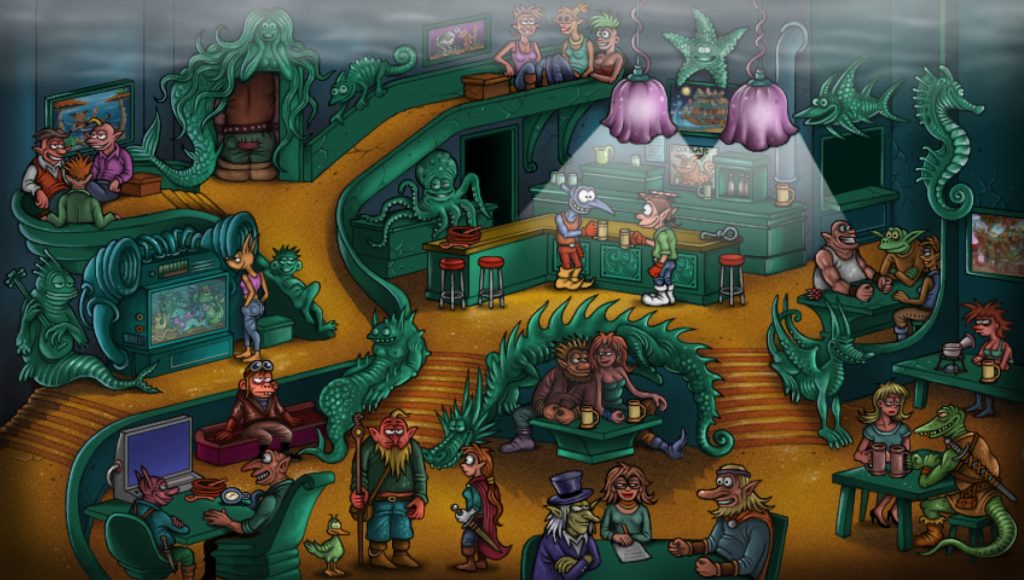
Gobliins 2 screenshot from MobyGames
Eventually Coktel Vision was closed and Pierre and Muriel split off to do their own things. I don’t think they ever had a falling out because they mention each other a bit in interviews and he did art for her book. I think they were just tired of games. Then in 2009 Pierre got the rights to the IP and made Gobliiins 4, which is…..ehhh. The 3D art is not amazing and it takes a long time to really get going, but it’s there I guess. My understanding is that the game improves quite a bit in the second half of the game. You cannot buy this one anywhere today and it’s abandonware. Muriel got a special thanks in this and I think consulted a little but wasn’t really involved.
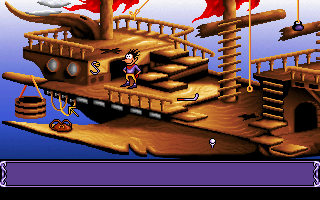
Goblins 3 screenshot from MobyGames
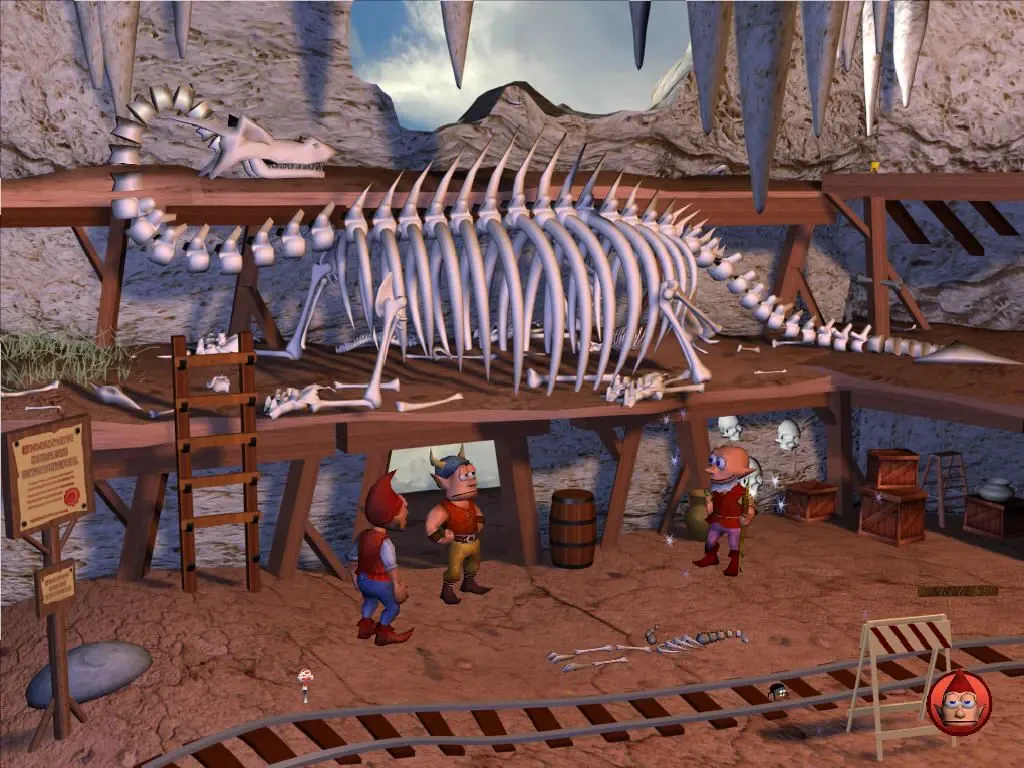
And then in 2023 he did a Kickstarter campaign to fund Gobliiins 5, which was made in Adventure Game Studio and has 2D art again. It’s great. It’s a return to form for the series and even with the janky setup (it’s split into four launchers because it was a solo project by an older guy learning a new game engine), it was a treat for fans. You can now get this on Steam and Itch.io. This repeated again two years later with another crowdfunding campaign for 6, which just came out this week. It was nice to see Muriel Tramis come back for this one to help with puzzle design and I hope this means she is back to making games again.
Gobliiins 4 screenshot from MyAbandonware
So what are the quirks with the series? Well, every entry in the series has a different number of i’s in the title based on the number of goblins you rotate between. So Gobliiins 1 has you switching between 3 characters, Gobliins 2 has two goblins, and Goblins 3 just has the one but you occasionally have other characters you play as anyway. Gobliiins 4 and 5 are sequels to the first game and have you playing as the three characters from the first game again and Gobliins 6 is a direct sequel to 2, where you play as the two characters from that one. Despite all this weird lore stuff, it doesn’t really matter. It’s just people walking around doing puzzles and goofy slapstick stuff happens.
Gobliiins 5 screenshot from Steam
If I were to recommend a game in the series to folks, I’d probably say to start with 3 or 5, depending on if you want something old school or not. It’s very hard to recommend 1 because it’s the only one with health meters where you lose health every time your characters get hit, which is when all the funny stuff happens, and uses a password system. The health system gets dropped with the second game and from here on, the goblins can get beat up as much as you want. The puzzle design gets better with each entry too, which 3 having much better puzzles than 2. The other weird quirk with the old ones is that people generally prefer the floppy disk versions over the cd-rom ones, because the music changed and people don’t care for it as much (I think it’s fine either way). You can pick up the original trilogy on GOG, which features both the floppy disk and cd-rom versions of the games.
Gobliins 6
Anyway, this is way too many words about a weird series of French games but I like my weird French DOS games so there you go.
I just realized I had a lot of sources I cycle between for abandonware games and thought it should be something to share, since this is just a blog and not a real games website, and I can post whatever I want. Abandonware, software that is no longer easily available because it is not sold anywhere by the publisher, is frequently a thing in games unfortunately and it doesn’t help that a lot of people just define it as “well this thing is old, so I can put it up for download even if it’s still for sale” which isn’t how preservation works! Anyway, here’s some sites I like that put care into what they upload, update them to work on modern versions of Windows, and take down the downloads if they get rereleased.
The Collection Chamber is the one I look at the most. It’s updated on a monthly basis and has a wide variety of stuff, with a focus on 90s games for Windows that you cannot easily run in DOSBox. It has so many games from the multimedia era that I find fascinating.
Zomb’s Lair has not been updated in a long time but hosts a lot of 90s computer games packaged for modern Windows as well. One of the most interesting ones to me is VNC: Virtual Nightclub, which was apparently an adventure game by the folks that made Burn: Cycle and was sold only through the Sci-Fi Channel phone line, so it was incredibly hard to find anything about it for a long time. I need to do a longer writeup on it sometime. It’s not “good” but it’s a fascinating time capsule of how we viewed the internet and virtual reality at the time.
Mr. Abandonware has organized a collection on the Internet Archive of DOS games packaged to run on modern windows, and it includes a lot of major games. lt’s kind of wild how many games that were commercial and critical hits just aren’t available for sale anywhere.
SentienceSnakes164 has a collection on the Internet Archive as well of games packaged to run on modern versions of Windows. This is more focused on 00s era games, mostly licensed ones that have been pulled from sale, but there’s some oddballs like early Monolith stuff and lesser known FPS like KISS: Psycho Circus.
There’s probably another post in me where I highlight freeware remakes of retro games, but I do want to give a shoutout to this one of Lode Runner: The Mad Monks’ Revenge. This was a game by Sierra that I really liked at the time and this remake adds likes of nice quality of life features.
Finally, MyAbandonware is a fascinating site to watch. It’s just constantly uploading stuff I never heard of. While it’s not focused on updating games to work on modern versions of Windows, they occasionally provide an update. This isn’t a criticism, no one could reasonably update all the games this site uploads.
That’s all I’ve got for this post. Feel free to add others in the comments as long as they aren’t uploading games that are still being sold.
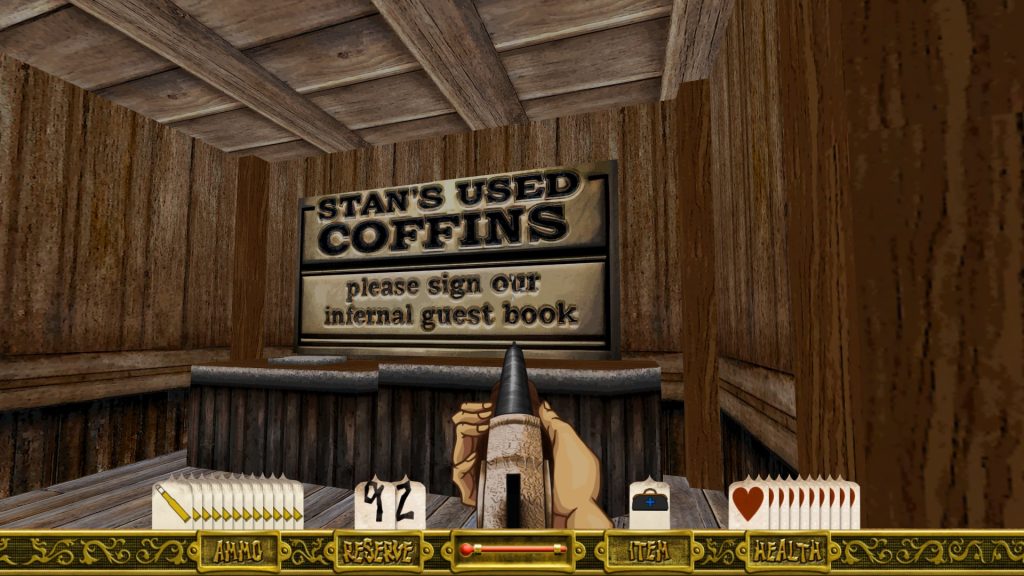
Outlaws is a FPS where you play as ex-Marshal James Anderson, looking to get revenge after outlaws murder your wife and kidnap your daughter. It was originally released in 1997 by Lucsarts and got a remaster from Nightdive. I felt compelled to check it out after The International House of Mojo did a negative review of it. Much like that reviewer, I remembered enjoying it. Was it really that bad? I had access to the remaster through Steam Family Sharing so I thought I would give it a shot and the TLDR is: meh. It’s not as bad as the review says, but also not as great as I remember either.
A fun little Monkey Island reference
I should probably talk about the good stuff first. The cutscenes and soundtrack are amazing. At this point in the life of Lucasarts, we were just starting to see them wind down on doing 2D animation in their games and cutscenes. Curse of Monkey Island also comes out in 1997, but I believe after this year they move fully into 3D and keep moving further into being a company that just makes Star Wars games. They still make quite a few good games after this point, I’m a huge fan of Grim Fandango (1998) and they continue making good Star Wars games, but to a certain fan we’re starting to reach the end of the line for the company. But Outlaws does an outstanding job using these cutscenes to tell the story between levels, and they look great. It’s probably the thing that keeps people thinking about the game. The soundtrack is great as well. It’s by Clint Bajakian and perfectly replicates the feel of classic westerns. I think anyone who is a fan of the game will tell you it’s the presentation that really wins them over.
The game itself feels very good to play. It’s built on the engine used for Dark Forces, so everything feels very solid. The weapon selection isn’t too bad either. It’s a little repetitive with the number of shotguns it offers you, but they did everything they could with the setting they had to work with. It’s built on a very solid foundation, so the game controls very well.
I think where the game starts to run into issues is the level design and mechanics of the game that it has to stick to due to the nature of it being a Western. The level designers did the best they could, but you can only do so much in a world design that still needs to be grounded in reality but plays like a fast-paced shooter. You’ll have very small towns or giant buildings like sawmills that you need to explore, but progress needs to be gated somehow and the only real option they have is from having locks and keys. They had a very limited number of design choices to choose from and it ultimately makes the game feel very repetitive. They tried to mix things up by having you on a moving train at one point, which I always love in FPS, and cliffs in another, which helps. The one level where it starts to get less grounded and you’re doing puzzles while sliding down streams in a lumber mill is my least favorite one, so maybe my theory is wrong. But Lucasarts had great level design in all of their other FPS, and the same folks worked on those, so that’s what I’m going to blame.
Due to it being a western you’re also just stuck fighting the same types of enemies repeatedly. Some may have shotguns or rifles, but there’s not a whole lot they could have done. There’s a boss enemy at the end of each level which is generally just a stronger person with a gun who may shoot faster, but I think those are still neat. They also have you shoot at big spiders at a few points which I absolutely hated as a kid. It’s still an odd thing. But that’s what I mean about them only being able to do so much, it’s a western so you’re shooting at various guys with guns and that’s it. The Mojo review mentions the enemies being very dumb and yeah, they are. They mostly stand there or pace back and forth, and sometimes shoot in the wrong direction, which was odd even at the time of the original release. Since the game was released in the 90’s, there was at least some awareness that the tropes in westerns could be very racist, so they avoid most of that, but not always! The brief moments where they run into those are not great. Most people don’t read manuals but I didn’t really care for the descriptions of some of the boss enemies either.
I think the remastered bits are perfectly fine. The new art for the enemies is built on the concept art and generally fits in ok with the rest of the 2D art in the game. The original game uses prerendered sprites of 3D models which I think can be charming, but I can’t imagine anyone new to the game preferring that over the remastered artwork. Luckily you can just enable and disable whatever you want, so it’s hard to see anyone getting mad over the new artwork. It also remaps the keys to fit in more with the control schemes of modern FPS, but I think there’s mods for the original game that can do this too? The only real part of the remaster that I got excited about was all the bonus materials showing concept art and other behind the scenes materials. It’s nice to see all of this here and preserved. If there’s a reason why you would pick this version up over the old one on GOG, it’s probably this.
I guess where I come down on Outlaws is that the game and remaster are fine. I think the other FPS by Lucasarts such as Dark Forces and Jedi Knight are much better due to how much more freedom they had in their design, but I wouldn’t call it a bad game either. I know that’s just a huge ringing endorsement for this game. I would have a very hard time telling people they should pay $30 for this, but if you ever see it on a deep discount and you have nostalgia for the original game then yeah, maybe you would enjoy revisiting the game. Sometimes you just shrug after playing a game and go “that was alright.”
Outlaws + Handful of Missions: Remaster is available on PC (Steam, GOG), PlayStation (PS4, PS5), and Xbox (One, Series X|S).
Developer: Living Books Publisher: Brøderbund Software, Inc. Year: 1992 Genre: Edutainment System: Macintosh
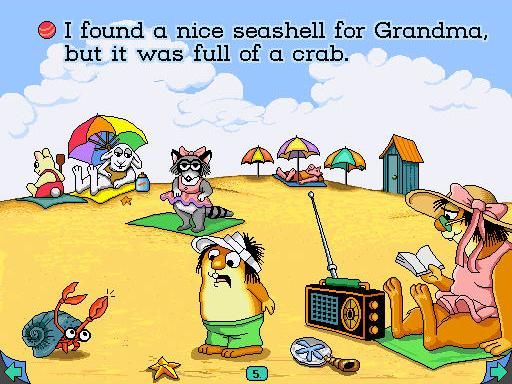
Yeah, that’s right. I’m reviewing a multimedia cd-rom. Just Grandma and Me is an interactive storybook based on the Little Critter book of the same name. You go through 12 screens of a book about Little Critter going to the beach with his grandma, which the game reads to you, and then you click on things to see funny little animations until you decide to go to the next page. There’s not a whole lot to it but it must work because my kids like it and I liked it when I first played it as a child too.
Screenshot taken from MobyGames
The first time I played it was when I was 6 years old and in my 1st grade classroom (if you want to know how old I was, it was September, 1993). The teacher put the cd-rom into the classroom’s Macintosh and I was blown away. Little Critter was talking and telling us which buttons we could push, and then started dancing to music. I had never seen a game do this before. This was my first time seeing a cd-rom as well, since we did have a PC (and Amiga before that) at home but they didn’t have cd-rom drives. I was so charmed by the story reading itself to me and all the funny animations that happened from clicking on stuff. Our family did eventually get a cd-rom drive about a month or two later and it came bundled with this game, which I played a lot along with later titles in the Living Books series.
A cd-rom is going to be a little less magical in 2026 (to some folks, not me!) but I think it still holds up, or at least my kids like it. The animations are still charming and it’s got a lot of funny little bits that happen when you click on stuff. Obviously it’s not a thing you’re still going to charge $30 or whatever for, but interactive storybooks are still a thing that kids enjoy and that’s what this is. Later releases of the game include a minigame or two as well as the ability to play in other languages. Plus with it having ScummVM support, you can play it on basically everything.
Fun fact: While he had plenty of success with his books, Mercer Meyer has a long history in computer games too. While most of his games are related to his Little Critter books, he did a few before this, including a text adventure.
Living Books: Just Grandma and Me is available on Steam and mobile platforms.
Developer: Humongous Entertainment Publisher: Humongous Entertainment Year: 1997 Genre: Adventure System: Windows
Something that’s been a lot of fun as my kids continue to grow has been revisiting games from my childhood. The most recent one has been Spy Fox in “Dry Cereal,” a point-and-click adventure by Humongous Entertainment. In the first Spy Fox game you play as a spy (who happens to be a fox, as it says on the tin) that rescue the world’s cows and stop William the Kid (a goat) from stealing the world’s supply of milk. Like everything else by Humongous Entertainment, this was a delight to revisit with my kids.
The game features the great art and animation you would expect from the studio. Everything still looks great today and the only real bummer about the current state of HE releases is that I do think they would look better at an even higher resolution. But at the same time I feel like that risks being twisted into something awful and we get an AI upscaling everything, so I’ll happily settle for how they look from the 90’s.
It’s also been fun seeing how carefully HE rolled out adventure games for children of all ages. Putt-Putt, Freddi Fish, and Fatty Bear were created for very young kids, 3-8 year olds, Pajama Sam is advertised for that age group too but I would argue is for an age range that is one year old, and Spy Fox is for 5-10 year olds. It’s just a tad bit more difficult than the rest of their adventures but roughly follows the same format and there being a core goal you complete through adventure game solving, one or two mini games you can play on the side, and possibly a real time sequence. I personally think the timed reaction sequences aren’t great and would remove them, but I think the rest of the game works.
The puzzles are trickier than what you would see in Putt-Putt and makes the game take longer to complete, but I don’t think it’s anything impossible for older kids. I think the only bit during the puzzle solving that doesn’t work for me is that Spy Fox has a limited inventory space for gadgets and to try other gadgets, you need to return to your HQ to swap out what you have for other gadgets. It’s a slog. I get why this approach was taken, the alternative is to just get everything and the HQ becomes a lot less interesting after that, but I maybe would have had other reasons to return to HQ and just let them have it all. Other than that though, I think the puzzles are interesting and it’s kinda fun that they start to introduce the idea of note taking to kids in this game.
Anyway, it’s a good game. I don’t know if I would recommend it to grownups to play by yourself but my kids loved it and I had fun playing it with them.
Spy Fox in “Dry Cereal” is available on Steam, Switch, PS4, and mobile platforms but ScummVM support means you can play it on basically everything.
Started making a silly little thing last night and put it on Itch. It’s just a goofy little generator for making ideas for games inspired by 80’s British computer games. Like it says on the page description, I’m poking fun at them but I do have a sincere love for that era of games (well maybe not Dizzy) and I like making my little generators so I thought to try making one in Twine. It’s obviously very early in development and I’m planning on making it look nicer as well as continuing to build on it so it can generate more ideas, but wanted to get it out there before I get distracted by something else. I’ll eventually put it here too because I like the idea of all my games also being hosted here in case something were to happen to Itch.
I should probably be working on my weekly indie game roundup post, maybe tomorrow, but instead I started a fansite for the 90s puzzle game Gubble. I thought of doing some kind of very specific fansite for a relatively obscure game for a long time now, at one point I wanted to do one for Pyst, but the Critical Distance fansite jam finally nudged me into starting one. It’s obviously a work in progress. Lots of pages aren’t done yet and I’ll continue adding more to the ones that I’ve already made. It turns out there’s lots I have to say about Gubble. But I’m going to keep it incredibly minimalist. It’s been fun toying with something only using extremely basic HTML and a tiny bit of CSS, and I’m going to keep it that way. Maybe you’ll consider making a fansite too?
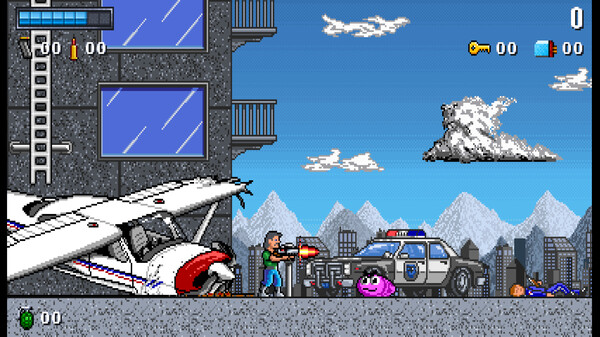
BioMenace Remastered is a very recent rerelease of the shareware classic BioMenace, which adds lots of graphics customization options and updates, and a brand new 4th episode of levels. You play as Snake Logan, a man with a mullet and mustache who must stop an evil scientist from destroying the world or something like that. It’s not the most important plot. All you need to know is that you are a guy with a sweet mullet who needs to rescue a hostage on each level and then leave. Sometimes you fight a boss. And it’s great. It’s not even a game I had much nostalgia for, my memories of the game at release were my dad struggling to get the shareware to work on our computer for some reason. The game holds up surprisingly well though, especially compared to some of the other shareware games from that era that I have nostalgia for but may be harder for me to recommend to others.
There’s not really much more to say about the actual gameplay. It’s all very straightforward but I think it feels good running around and shooting at monsters. There’s a demo on Steam so if you find it enjoyable, the rest of the game is more of that. I mentioned before that I really liked the Crystal Caves remaster and even though this is by different devs, this feels like it builds on that and the Secret Agent remaster by offering even more graphics customization options as well as the extra episode and level builder that seems to be expected from these. If you want to play with the original graphics you certainly can, but the game’s new modern mode looked great to me and I actually stuck with that for most of the time. It even lets you enable and disabled various bits so if you want to play with the original art but in widescreen mode, you can! I believe these devs did a Duke Nukem remaster or rerelease for the Evercade that may have similar options, but I don’t own one so I can’t speak for that.
The additional episode 4 is great. It introduces a lot of new little level design tricks that keep it feeling fresh the entire time and the levels are a bit larger in scope so it takes more time to play through than the original three episodes. There’s a fun little cameo by someone from another shareware game that made me so happy when I saw it.
Anyway, that’s all I have to say about this one. I think the game holds up and this seems like the ideal way of remastering these old shareware platformers. I hope it does well and we keep getting more of them. I know they exist for Crystal Caves, Secret Agent, and Monsters Bash (these being all by Emberheart), with one for Cosmo’s Cosmic Adventure on the way, but I’ll keep playing more of them if they’re as good as the ones we’ve already got.